📢 Editorial Notice
This article was published later than originally planned due to the migration of KPOP82 from Blogger to WordPress. Thank you for your understanding.
👉 Read more: Important Notice About KPOP82’s WordPress Migration
Editor’s Note: This preview was originally prepared before BTS’s October 2–3, 2026 concerts in Bogotá. Its forward-looking language has been preserved to reflect the anticipation surrounding the performances at that time.
K-POP TODAY #95
🌍 Bogotá Preview → Day 1 Review
Before Bogotá became a roar of more than 53,000 voices, it was a city counting down to a long-awaited first meeting.
👉 BTS Bogotá Preview | The Latin American Chapter Begins at El Campín
. . .
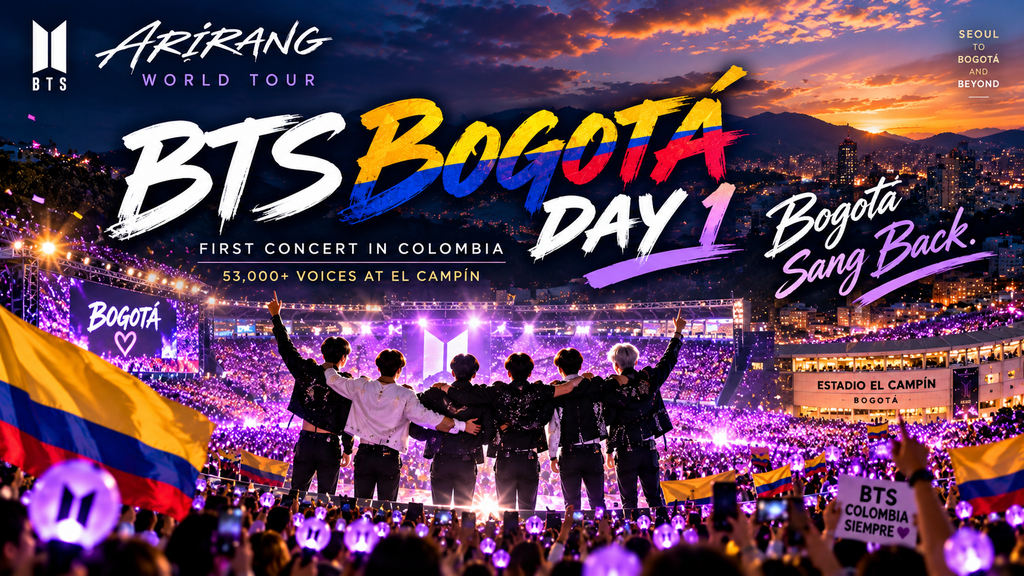
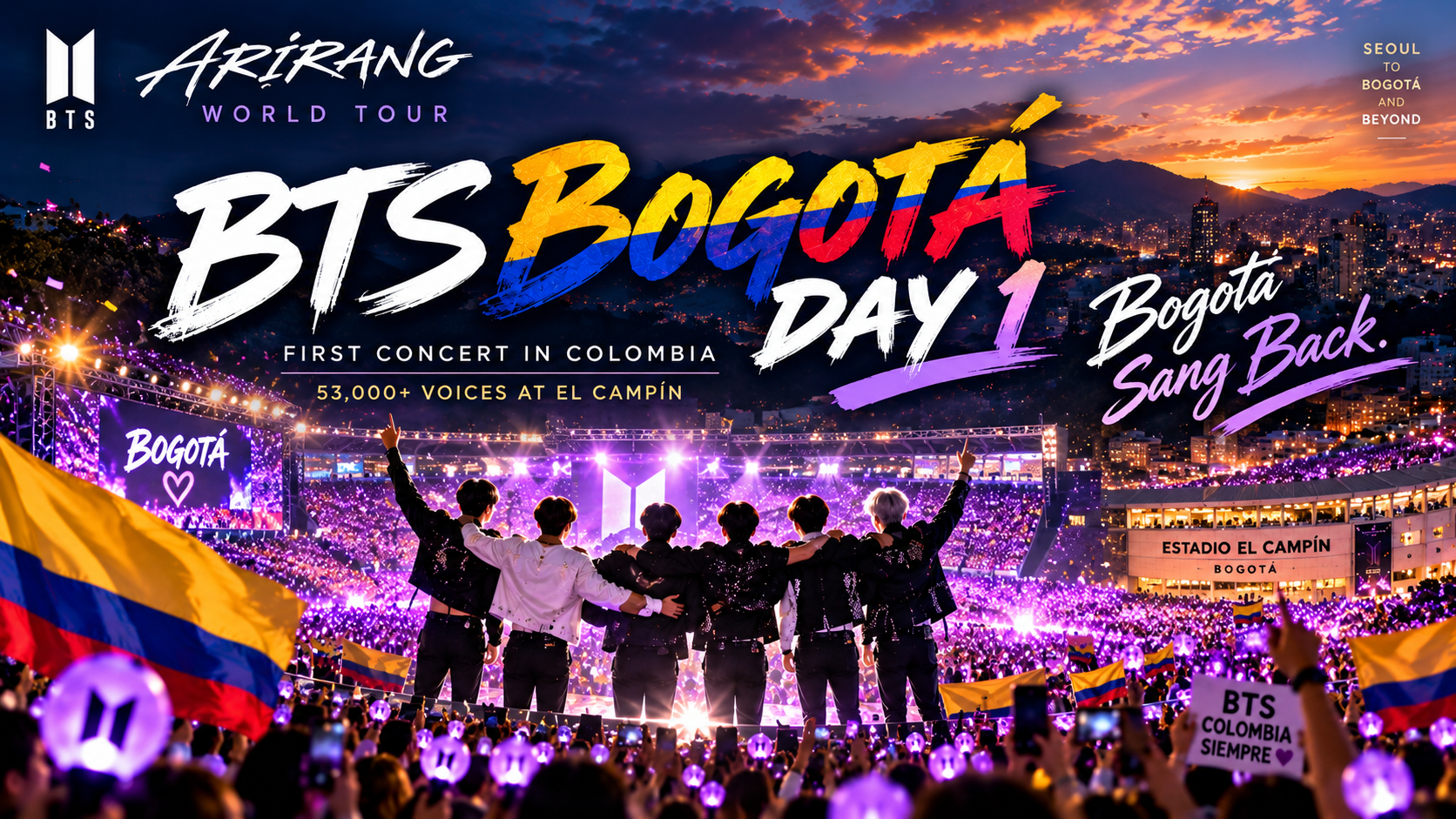
BTS Bogotá Day 1 Review – First Concert in Colombia
Opening
For years, Bogotá waited.
Then the lights went down.
And more than 53,000 voices answered at once.
On October 2, 2026, BTS finally stood inside Estadio Nemesio Camacho El Campín for their first concert in Colombia.
The distance that had separated Seoul and Bogotá for years suddenly became irrelevant.
BTS was no longer on a screen.
Colombian ARMY was no longer watching another city celebrate from thousands of kilometers away.
They were finally in the same place.
And Bogotá did not welcome BTS quietly.
It sang back.
The Night Bogotá Had Been Waiting For
Long before the first song, the scale of the anticipation was visible outside El Campín.
Some fans had gathered around the stadium from the early hours of October 2. Local reporting described more than 400 people waiting near the venue before doors opened, with tents, blankets and luggage appearing around the stadium.
The two Bogotá concerts were sold out, with more than 53,000 people expected each night.
This was not simply another Friday concert.
It was BTS’s first performance in Colombia.
Years of waiting had been compressed into one date:
October 2, 2026.
Then the stadium lights changed.
The show began.
And the waiting became memory.
More Than Two Hours, 23 Songs
The first Bogotá concert lasted more than two hours and, according to local coverage, moved through a 23-song set that crossed different chapters of BTS’s musical identity.
The opening sequence began with “Hooligan” and “Aliens”, followed by “Run BTS.”
From there, the concert moved through songs including “FAKE LOVE,” “Not Today,” “MIC Drop,” “Fire,” “IDOL,” “Butter” and “Dynamite,” before reaching its closing stretch.
But a setlist alone cannot explain what happened inside El Campín.
A song title tells us what BTS performed.
It does not tell us what Bogotá did with it.
And that may have been the defining story of Day 1.
Bogotá Did Not Simply Listen
Anyone following fan videos from the first night quickly noticed something.
The crowd was loud. Very loud.
Not only during entrances or between songs.
Colombian ARMY sang with BTS.
They knew the lyrics.
They knew the movements.
They reacted before familiar moments arrived.
Thousands of synchronized light sticks transformed the stands into part of the production, while the voices coming from those stands sometimes seemed almost as important as the sound coming from the stage.
Soon, fans watching online began making comparisons with another famously intense Latin American ARMY crowd:
Mexico City.
Could Bogotá’s singalong have been even louder?
There is no official sound measurement that can answer that question, and a stadium crowd should not be turned into a competition.
But the fact that people were asking the question tells us something.
Bogotá had waited years for this night.
And when it finally came, the city did not simply watch.
Bogotá participated.
That distinction matters.
Because the most memorable stadium concerts are rarely performances delivered in only one direction.
The stage sends something outward.
The audience sends something back.
For more than two hours at El Campín, that exchange rarely seemed to stop.
Korean Songs, Colombian Voices
There is something extraordinary about hearing tens of thousands of people sing words created thousands of kilometers away.
Most of the people inside El Campín did not grow up speaking Korean.
They grew up speaking Spanish.
Their city belongs to the Andes, not the Korean Peninsula.
Their histories are different.
Their cultures are different.
Yet music had already taught them a shared vocabulary.
A chorus.
A phrase.
A rhythm.
A name.
BTS.
That is one of the strange powers of modern global music.
Language can remain different while emotion becomes recognizable.
And on Day 1, Bogotá demonstrated that global fandom does not require cultural sameness.
It requires connection.
Seven Members, A Few Colombian Words
Near the end of the concert, another kind of connection appeared.
RM, Jin, SUGA, j-hope, Jimin, V and Jung Kook sat together and addressed the Colombian audience.
Some spoke in Korean with interpretation.
Others tried Spanish.
Local expressions entered the conversation.
Laughter followed.
The distance between global superstar and local audience briefly became smaller.
According to Colombian reporting, the members thanked ARMY and spoke about returning to Bogotá. They also expressed the hope of performing in an even larger venue in the future so that more fans could attend.
For an audience experiencing BTS in Colombia for the first time, those words carried weight.
The first meeting was already becoming a promise of another.
But there is another reason why the relationship between Korea and Colombia deserves a deeper look.
It began long before K-pop.
Long before BTS.
Long before anyone inside El Campín was holding a purple light stick.
. . .
Mid Insight — Before Music Crossed the Pacific, Colombian Soldiers Did
For Koreans, Colombia is not simply another country on a world-tour map.
There is history between these two countries.
The Korean War began on June 25, 1950, when North Korean forces crossed the 38th parallel and invaded South Korea.
The fighting devastated the Korean Peninsula for more than three years.
It was finally halted on July 27, 1953, when the Korean Armistice Agreement was signed.
It is important to call it an armistice rather than a peace treaty.
The agreement stopped the fighting, but it did not constitute a formal peace settlement ending the war.
And during those terrible years, a country on the other side of the world answered Korea’s call for help.
Colombia.
Colombia became the only Latin American nation to send combat forces to Korea.
It contributed both an infantry battalion and naval forces.
Across the Korean War effort, approximately 5,100 Colombian servicemen participated.
They crossed the Pacific to fight in a country many of them had probably never seen before.
Colombian troops fought in difficult engagements, including battles around Kumsong and the outpost fighting associated with Old Baldy and other contested positions.
They paid a heavy price.
Korean government records count hundreds of Colombian casualties, including men killed, wounded and captured.
Those numbers should not be reduced to historical trivia.
They were young Colombians.
They had families.
They had lives waiting for them on the other side of the Pacific.
Some never returned.
Others returned carrying wounds and memories from a country thousands of kilometers from home.
Korea remembers them.
Seventy-Five Years Later, The Journey Crossed the Pacific Again
Now consider the image inside El Campín on October 2, 2026.
More than seven decades after young Colombian servicemen traveled west across the Pacific toward a Korea devastated by war, seven Korean musicians had traveled in the opposite direction.
Not carrying weapons.
Carrying music.
Waiting for them were tens of thousands of Colombians singing Korean words.
These two journeys should never be treated as equivalent.
One belongs to war, sacrifice and death.
The other belongs to music, youth and celebration.
But history gives the distance between Korea and Colombia a meaning that a concert map alone cannot show.
Before purple lights connected Seoul and Bogotá, another generation of Colombians had already crossed that distance.
Before Korean music reached Colombia, Colombian soldiers had reached Korea.
And that makes one simple sentence worth saying.
For Korea, Colombia is an old friend.
From Battlefield Memory to Stadium Light
History sometimes creates connections that reveal themselves only decades later.
In 1951, Colombian troops arrived on the Korean Peninsula.
In 2026, BTS arrived in Bogotá.
The people are different.
The generations are different.
The circumstances could hardly be more different.
Yet both stories exist inside the longer relationship between two countries separated by the Pacific.
Perhaps some of the young ARMY singing inside El Campín knew this history.
Perhaps many did not.
And perhaps many global ARMY reading this story have never heard it before.
That is precisely why it deserves to be remembered here.
A world tour does more than connect venues.
Sometimes it reveals histories hiding underneath the route.
Seoul → Bogotá is not merely a flight path.
There are memories along that line.
When 53,000 People Become One Voice
Then the history lesson ends.
The stadium returns.
The lights return.
The music returns.
And there is Bogotá again — singing.
This may ultimately be the image that survives Day 1.
Not a particular costume.
Not one piece of choreography.
Not even one song.
The crowd.
Tens of thousands of people producing something that no individual voice could create alone.
A stadium singalong is an unusual human experience.
Most people inside the building are strangers.
They come from different neighborhoods, cities and even countries.
They have different ages, occupations and lives.
Outside the stadium, they may never meet.
But a familiar opening note begins.
And suddenly everyone knows what to do.
One voice becomes ten.
Ten become a thousand.
A thousand become tens of thousands.
For several minutes, strangers sound like one body.
Bogotá understood that instinctively.
The First Night Can Never Happen Again
There will be another BTS concert at El Campín.
Day 2 will have its own moments.
Its own reactions.
Its own memories.
Perhaps it will be louder.
Perhaps it will be more emotional.
Perhaps something completely unexpected will happen.
We do not know yet.
But Day 2 can never reproduce one thing from October 2.
The first time.
There can only be one moment when BTS first walks onto a Colombian stage.
One first roar.
One first greeting.
One first Colombian ARMY ocean seen by all seven members together.
One first final bow.
That now belongs permanently to October 2, 2026.
Bogotá waited years for it.
And then, in a little more than two hours, it became history.
Author’s Insight — Colombia Sang Back
Before the concert, we asked a question:
What would Bogotá sound like when BTS finally arrived?
Day 1 gave us the answer.
It sounded like tens of thousands of people refusing to remain spectators.
It sounded like Spanish and Korean sharing the same stadium.
It sounded like songs that had crossed an ocean long before the artists themselves finally did.
And underneath that music lies another, much older connection.
On June 25, 1950, war began on the Korean Peninsula.
On July 27, 1953, the armistice halted the fighting.
Between those dates, thousands of young Colombians traveled halfway around the world to stand beside a country fighting for survival.
Some gave their lives there.
Korea has not forgotten.
Seventy-five years later, the sound traveling between these two countries is different.
No artillery.
No battlefield.
No young soldiers crossing the Pacific toward war.
Instead:
Music.
Light.
A stadium.
Seven Korean artists.
And more than 53,000 Colombian voices singing back.
That is not a comparison between war and a concert.
It is something quieter.
A reminder that relationships between countries can outlive generations and find entirely new languages.
Once, Colombia came to Korea.
On October 2, Korea came to Colombia in another form.
And Bogotá welcomed it with a roar.
For Korea, Colombia is an old friend.
On Day 1 at El Campín, that old friendship found a new language.
Music.
And now one question remains.
If this was Bogotá’s first night—
what will Day 2 add to the story?
. . .
🌍 Bogotá Day 1 Review → Day 2 Review
Bogotá’s first night is now history. But El Campín still has one more story to tell.
👉 BTS Bogotá Day 2 — Coming Next
👉 BTS Universe | The Gateway to KPOP82
👉 Start here: Ultimate Guide to K-POP SONGS BLOG