📢 Editorial Notice
This article was published later than originally planned due to the migration of KPOP82 from Blogger to WordPress. Thank you for your understanding.
Read more: Important Notice About KPOP82’s WordPress Migration
Bogotá | Global Cities One Song
🌍 Follow the ARIRANG Journey
The ARIRANG journey has crossed continents and connected cities through music. Before BTS takes the stage in Colombia, explore how each stop has added its own voice to one global story.
👉 BTS ARIRANG World Tour — Every City. Every Story. One Journey.
– – –
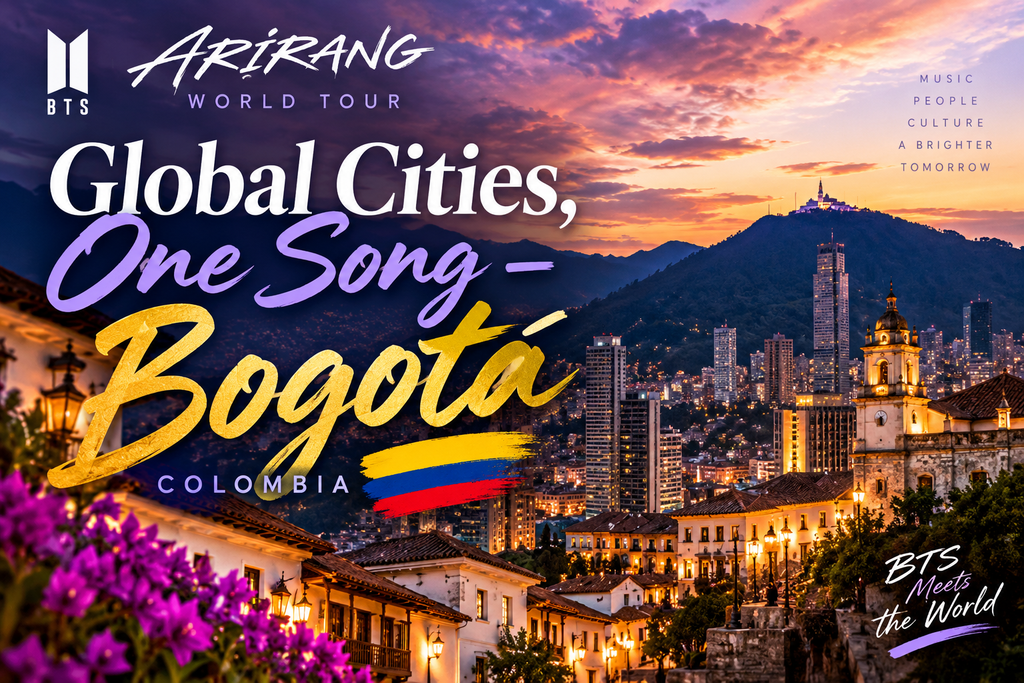
Global Cities, One Song — Bogotá
Opening
At more than 2,600 meters above sea level, Bogotá has always lived a little closer to the sky.
The Colombian capital stretches across a high plateau in the Andes, where mountains rise beyond the eastern edge of the city and the weather can change almost without warning. Old streets meet modern towers. Colonial façades stand beside murals.
Traditional Colombian rhythms coexist with rock, jazz, hip-hop, salsa, vallenato, electronic music, and sounds arriving from every corner of the world.
And now, another sound is approaching.
On October 2 and 3, 2026, BTS will perform at Estadio Nemesio Camacho El Campín, opening the Latin American leg of the BTS WORLD TOUR ‘ARIRANG’. The Bogotá city government expects more than 53,000 people to attend each night.
For BTS, these concerts carry another distinction: they mark the group’s first performances in Bogotá.
But before the stadium lights come on, there is another story worth telling.
Because Bogotá is not simply a city waiting for BTS.
Bogotá is already a city that knows how to sing.
A Capital Built High in the Andes
Bogotá is Colombia’s capital and one of South America’s great high-altitude metropolises.
Official tourism sources place the city roughly 2,600–2,640 meters above sea level. Its elevation gives Bogotá a climate quite different from the tropical image many visitors may associate with Colombia: cool mornings, mild afternoons, sudden rain and chilly evenings can all belong to the same day.
Look east and the Andes provide the city’s natural wall.
Look inward and another landscape appears.
La Candelaria preserves layers of Bogotá’s colonial history through narrow streets, churches, plazas and brightly painted buildings. Museums hold treasures from Colombia’s pre-Hispanic and modern artistic traditions. Monserrate watches over the capital from the mountains above.
Yet Bogotá cannot be understood only through monuments.
Its real character is found in movement.
Students fill cafés. Street artists turn concrete walls into enormous canvases. Vendors move through crowded avenues. Cyclists cross the city. Music escapes from restaurants, bars, theaters, parks and passing cars.
Bogotá feels less like a museum of Colombian culture than a place where many versions of Colombia meet every day.
That makes it an especially fitting city for a tour called ARIRANG.
A song rooted in one country’s cultural memory is arriving in another country whose identity has also been shaped by many regions, histories and voices.
Two traditions do not have to sound alike to recognize something in each other.
Bogotá Is a City of Music
There is an important fact behind that description.
In 2012, Bogotá was designated a UNESCO Creative City of Music, recognition connected to the diversity of its traditional, popular, urban, academic and experimental music scenes.
Music here is not confined to concert halls.
The city’s well-known Festivales al Parque have brought different genres into public spaces: Rock al Parque, Jazz al Parque, Hip Hop al Parque, Salsa al Parque, Colombia al Parque and other festivals have helped make large-scale public music part of Bogotá’s cultural identity.
That matters to the story unfolding this week.
BTS is not bringing music into a silent city.
They are entering a city that already understands what happens when thousands of strangers gather around sound.
Bogotá knows the transformation.
A park becomes a venue.
A crowd becomes a chorus.
A song that belonged to one artist suddenly belongs, for a few minutes, to everyone singing it.
K-pop arrived from thousands of kilometers away, in another language and another cultural tradition. Yet the emotional mechanism is familiar.
That may be one reason music travels farther than geography suggests it should.
From Seoul to Bogotá
Seoul and Bogotá seem distant on a map.
They are separated by the Pacific Ocean, languages, histories and more than 14,000 kilometers of geography.
Yet global pop culture has steadily shortened that distance.
For Colombian fans who discovered BTS through a screen, a music video, a streaming platform or another ARMY’s recommendation, Korea gradually became less abstract.
A Korean phrase could become familiar.
A song released in Seoul could become part of someone’s commute in Bogotá.
Seven artists on a screen could become associated with a particular period of someone’s life.
This is one of the quiet revolutions created by global music.
People no longer need to share geography before they share emotion.
And that is why October 2 is more than another date on a tour calendar.
For Bogotá ARMY, the distance between watching and being there is about to disappear.
For the first time, the city does not have to experience BTS from afar.
BTS is coming to Bogotá.
El Campín: When a Stadium Becomes a Meeting Place
At the center of this encounter stands Estadio Nemesio Camacho El Campín.
The stadium is one of Bogotá’s major sporting landmarks, but on October 2 and 3 its familiar role will change.
Football lines will give way to a concert stage.
Team colors will meet another color familiar around the world: purple.
Bogotá’s official tourism portal lists the BTS concerts for October 2 and 3 at El Campín, while the city government estimates attendance of more than 53,000 people per date.
That means more than 100,000 concert attendances across the two nights if the city’s projections are realized.
But numbers explain only scale.
They do not explain anticipation.
Some fans will have waited years for this moment. Some will travel from other Colombian cities. Others will cross national borders. Some will arrive carrying light sticks, banners or carefully prepared outfits.
Different journeys.
Different stories.
One destination.
For two nights, El Campín becomes the point where all of those individual journeys converge.
– – –
Mid Insight — Distance Changes Meaning When Music Crosses It
World tours are usually described through numbers.
Cities.
Dates.
Stadium capacities.
Tickets.
Kilometers.
But those numbers miss something important.
The real distance between Seoul and Bogotá cannot be measured only in kilometers.
For years, music has been crossing that distance instantly.
A song released in Korea could reach Colombia within seconds. A lyric could be translated by fans. A performance could be replayed thousands of times. Online communities could form friendships between people who had never stood in the same room.
The physical journey came later.
That is what makes a first concert different.
The music arrived years ago.
The artists are arriving now.
ARIRANG Finds Another Mountain City
There is also something poetic about where this Latin American chapter begins.
The word Arirang carries deep associations with Korean cultural memory. Its many traditional versions have traveled through generations, often evoking ideas of separation, longing, journey and reunion.
Now the name travels with BTS.
From Korea to North America.
Across Europe.
And now into South America.
Bogotá offers an unexpected visual echo.
This, too, is a city shaped by mountains.
Not the mountains of Korea, and not the same history.
But mountains still affect the way a city sees itself. They become direction, horizon, weather and memory.
On one side of the world, a Korean song associated with generations of journeys.
On another, an Andean capital preparing for a new musical arrival.
There is no need to pretend these traditions are the same.
Their difference is precisely what makes the meeting interesting.
Global culture becomes meaningful not when every place becomes identical, but when something created in one place can arrive somewhere else and acquire another layer of memory.
After October 2 and 3, ARIRANG will also have a Bogotá memory.
More Than a Concert Arrives in Bogotá
The scale of the event reaches beyond the stadium.
Bogotá’s city government said the two concerts are expected to generate more than 99 billion Colombian pesos in attendee spending, with thousands of domestic and international visitors arriving for the shows.
Hotels receive guests.
Restaurants fill tables.
Drivers carry visitors across the city.
Fans explore neighborhoods.
Coffee shops become meeting points.
Local businesses encounter travelers who might never have come to Bogotá at this particular moment without music.
This is one reason a world tour can become more than a sequence of performances.
Every stadium concert temporarily creates a small cultural ecosystem around itself.
The artist moves.
The audience moves.
Money moves.
Stories move.
And sometimes a person who travels for a concert returns home remembering the city just as strongly as the performance.
That is where Global Cities, One Song begins.
Not inside the stadium.
Outside it.
The City Before the First Note
There is a special moment in every tour stop that disappears once the concert begins.
The day before.
Nothing has happened yet.
The stage may be taking shape. Merchandise plans are ready. Fans check tickets again. Travelers arrive with suitcases. Group chats become busier. Weather forecasts are refreshed repeatedly.
The city continues its ordinary life while thousands of people privately count down toward the same hour.
Bogotá is in that moment now.
October rain may come.
The mountain air may turn cold after sunset.
Traffic will move through the avenues.
Lights will appear across the high plateau.
And somewhere among millions of people living their ordinary Thursday, thousands of ARMY will be thinking the same thing:
Tomorrow.
Tomorrow, years of watching from Colombia become a night inside El Campín.
Tomorrow, Bogotá becomes the first stop of the Latin American chapter of the ARIRANG journey.
Tomorrow, distance becomes presence.
Author’s Insight — One Song Does Not Erase Borders. It Crosses Them.
Perhaps the most remarkable thing about global music is not that it makes every city look the same.
It does the opposite.
Every city changes the song.
A BTS concert in Seoul carries Seoul.
A night in Mexico City carries Mexico City.
Madrid adds Madrid.
London adds London.
Paris adds Paris.
And Bogotá will add something that no previous stop could provide.
Colombia.
The Andes.
Spanish voices singing Korean words.
A city more than 2,600 meters above sea level becoming part of a musical journey that began on the other side of the planet.
That is why this series is called Global Cities, One Song.
The cities remain different.
The languages remain different.
The histories remain different.
But for several hours, people who may never meet again agree on one rhythm.
Tomorrow night, tens of thousands of lights will rise inside El Campín.
Outside the stadium, Bogotá will remain Bogotá — complicated, energetic, historic, modern, Colombian.
Inside, another memory will begin.
One city.
One first meeting.
One song crossing the Andes.
Welcome to Bogotá.
The Latin American journey is about to begin.
And the next question is no longer whether BTS can reach this city.
They already have.
The question now is:
What story will Bogotá send back to the world?
– – –
🌍 The Journey Continues — Bogotá Preview
Bogotá has told us who it is. Now the stadium is ready to tell the next story.
Continue to → BTS Bogotá Preview — The Latin American Chapter Begins at El Campín
👉 BTS Universe | The Gateway to KPOP82
👉 Start here: Ultimate Guide to K-POP SONGS BLOG